
The Anderson-Darling test
It is a statistical test used to test whether a sample of data comes from a particular theoretical distribution. Unlike the Kolmogorov-Smirnov test, the Anderson-Darling test assigns greater weights to the tails of the distribution, making it more sensitive to discrepancies in these areas.
How to Interpret It?
Null Hypothesis (H0): the data comes from the specified theoretical distribution.
Alternative Hypothesis (H1): the data does not come from the specified theoretical distribution.
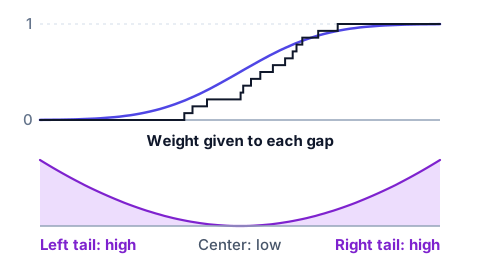
The test calculates a test statistic (Aˆ2) that measures the discrepancy between the empirical distribution function of the data and the expected theoretical distribution.
Critical values and significance: these values are used to compare the calculated A² statistic with a critical value corresponding to a given level of significance.
If the A² statistic is greater than the critical value, the null hypothesis is rejected.