
Behavioral Finance
Behavioral finance challenges the traditional assumption that investors are rational actors who process information objectively and make optimal decisions. Instead, it incorporates insights from psychology to explain how cognitive biases, emotions, and social influences systematically affect investment decisions and market outcomes. This field emerged from observations that markets frequently exhibit anomalies that cannot be explained by traditional efficient market theory. Understanding behavioral finance is crucial for investors and financial professionals as it helps explain market inefficiencies, predict investor behavior patterns, and develop strategies that account for human psychological tendencies in financial decision-making.
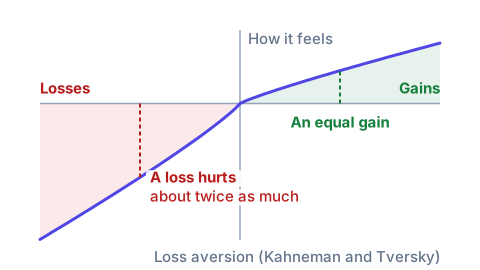
Cognitive biases represent systematic errors in thinking that affect investment decisions and market behavior. Confirmation bias leads investors to seek information that supports their existing beliefs while ignoring contradictory evidence, often resulting in overconfidence in poor investment choices. Anchoring bias causes investors to rely too heavily on the first piece of information encountered, such as a stock's historical high price, when making subsequent decisions. Loss aversion, identified by Kahneman and Tversky, demonstrates that people feel the pain of losses approximately twice as strongly as the pleasure of equivalent gains, leading to poor portfolio decisions like holding losing positions too long and selling winners too early. Overconfidence bias causes investors to overestimate their knowledge and ability to predict market movements, resulting in excessive trading and poor diversification. Mental accounting leads people to treat money differently based on arbitrary categories, such as viewing gambling winnings as "play money" rather than real wealth.
Market anomalies provide compelling evidence of behavioral influences on asset pricing, challenging the efficient market hypothesis. The momentum effect shows that stocks with strong recent performance tend to continue outperforming in the short term, contradicting the random walk theory. Conversely, the value premium demonstrates that historically cheap stocks (high book-to-market ratios) outperform expensive stocks over longer periods, suggesting markets systematically misprice securities. The January effect reveals that small-cap stocks typically outperform in January, potentially due to tax-loss selling in December followed by reinvestment. Post-earnings announcement drift shows that stock prices continue moving in the direction of earnings surprises for several quarters, indicating markets initially underreact to new information. The disposition effect, where investors sell winning investments too early while holding losing investments too long, creates predictable price patterns that contradict optimal portfolio management principles.
Investor psychology and social dynamics create powerful forces that drive market cycles and bubble formation. Herd behavior occurs when investors follow the crowd rather than their own analysis, amplifying market trends and creating momentum that can persist beyond fundamental justification. Fear and greed cycles drive market volatility as periods of optimism lead to risk-taking and asset price inflation, while periods of pessimism cause risk aversion and market declines. Social proof bias leads investors to assume that popular investment choices must be correct, contributing to speculative bubbles. Availability bias causes investors to overweight recent or memorable events when assessing probabilities, leading to poor risk assessment after market crashes or periods of unusual volatility. Recency bias makes investors extrapolate recent performance too far into the future, causing cyclical patterns of overvaluation and undervaluation across different asset classes and market sectors.