
Black and Scholes Model
Also known as the Black-Scholes-Merton or BSM model, it's a differential equation that's widely used to calculate the theoretical value of an option.
It has had a profound impact on finance and has led to the development of a wide range of derivative products such as futures, swaps, and options.
Scholes and Merton were awarded the Nobel Memorial Prize in Economic Sciences in 1997 for their work in finding "a new method to determine the value of derivatives" (Black had passed away two years earlier so he could not be a recipient because Nobel Prizes are not given posthumously).
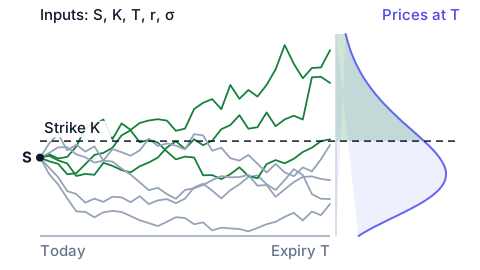
The Black-Scholes model makes certain assumptions: no dividends are paid out during the life of the option, markets are random because market movements can't be predicted, there are no transaction costs in buying the option, the risk-free rate and volatility of the underlying asset are known and constant, the returns of the underlying asset are normally distributed, the price of assets follows a geometric Brownian motion with constant drift and volatility and the option can only be exercised at expiration.
Geometric Brownian Motion (GBM) is a stochastic process widely used in financial mathematics to model the dynamics of asset prices over time. It is characterized by its continuous paths and the property that the logarithm of the asset price follows a Brownian motion with drift.
This mathematical formulation is particularly significant in the context of the Black-Scholes option pricing model, where it serves as a fundamental assumption for the behavior of stock prices. The GBM model captures the essence of price movements in financial markets by incorporating both the random fluctuations inherent in asset prices and the deterministic trend that reflects expected returns.