
Bonds
Bonds are debt securities issued by governments, municipalities, or corporations to raise capital, representing a loan made by investors to these entities. In exchange for lending money, bondholders receive periodic interest payments (coupons) and the return of principal at maturity. Bonds serve as the backbone of global fixed-income markets, providing predictable income streams and portfolio diversification benefits while playing a crucial role in financing government operations and corporate growth.
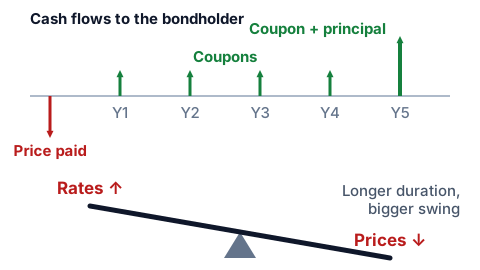
The bond universe encompasses various types differentiated by issuer, duration, credit quality, and structure. Government bonds, issued by sovereign entities, typically offer the highest security and serve as benchmarks for other debt securities. Corporate bonds carry higher yields but greater credit risk, while municipal bonds often provide tax advantages. Duration-wise, short-term bonds (under 2 years) offer stability, medium-term bonds (2-10 years) balance risk and return, and long-term bonds (over 10 years) provide higher yields but greater interest rate sensitivity. Credit quality ranges from investment-grade bonds (BBB- and above) to high-yield or 'junk' bonds (BB+ and below). Structural variations include fixed-rate bonds with set coupons, floating-rate bonds with variable payments, zero-coupon bonds sold at discounts, and inflation-linked bonds that protect against purchasing power erosion.
Bond prices are influenced by several key factors, most notably interest rates, which have an inverse relationship with bond prices: when rates rise, existing bond prices fall, and vice versa. This sensitivity is measured by duration, with longer-term bonds exhibiting greater price volatility. Credit risk affects the spread between bond yields and risk-free rates, with rating agencies like Moody's, S&P, and Fitch providing credit assessments. Inflation erodes the real value of fixed-rate bonds, making inflation-linked securities attractive during inflationary periods. Key metrics for bond analysis include Yield to Maturity (YTM), which represents total return if held to maturity; duration, measuring interest rate sensitivity; convexity, capturing the curvature of the price-yield relationship; and credit spreads, indicating the risk premium over government securities.