
Delta Hedging
Delta hedging is a sophisticated risk management strategy that allows traders and portfolio managers to neutralize directional price risk in portfolios containing options and stocks. At its core, this technique revolves around maintaining your portfolio's delta at a specific target level. Delta represents how much your portfolio value changes when the underlying asset moves by one dollar. For instance, if your portfolio has a delta of 0.50, you gain $50 for every $1 increase in the underlying stock price. Most institutional traders aim for delta-neutral portfolios (target delta = 0) to profit from time decay and volatility rather than directional moves.
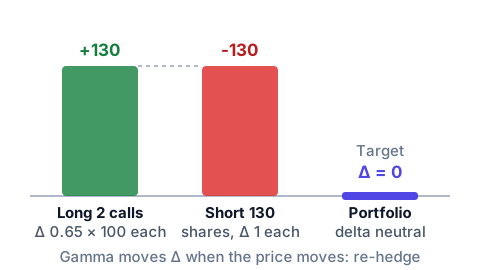
Understanding portfolio delta begins with recognizing that different positions contribute differently to your overall exposure. Stock positions have a delta of exactly 1.0 per share, meaning 100 shares give you +100 delta. Options, however, have fractional deltas that change based on how far they are in-the-money and how much time remains until expiration. A call option might have a delta of 0.65, meaning each contract (typically representing 100 shares) contributes +65 to your portfolio delta. When you combine multiple positions across different strikes and expirations, calculating total portfolio delta becomes complex, which is where systematic tools become invaluable.
Gamma represents the rate of change in delta and is often called the "delta of delta." High gamma positions, particularly those near expiration or close to the money, cause your delta to change rapidly as prices move. This creates both opportunities and risks. On one hand, gamma can work in your favor if you're positioned correctly. On the other hand, it can quickly push your portfolio away from your target delta, requiring frequent and sometimes expensive adjustments. Understanding gamma projections helps you anticipate how different price scenarios will affect your delta exposure, allowing for more strategic hedging decisions.
When it comes to actual hedging implementation, traders have several approaches available. The most precise method involves using the underlying stock itself: if you need to reduce positive delta, you short sell shares; if you need to increase delta, you buy shares. This stock hedging approach offers 100% precision but requires substantial capital and margin capacity. Alternatively, you can use options to hedge, which requires less capital but introduces time decay risk. Many sophisticated traders employ hybrid approaches, using a combination of stocks and options to balance capital efficiency with hedging precision.
With several underlyings, a delta on one stock and a delta on another are not the same unit: one share of a 500 dollar stock moves the book five times more than one share of a 100 dollar stock. Portfolio-wide hedging therefore measures each asset as money (delta times spot, converted to a base currency) and asks how to close the gap to the target for the whole book. The proportional route lets every asset cover its own share with its own shares, puts or calls: no assumption about how the assets move together. The concentrated route covers everything with a single asset, which only works to the extent the others move with it; that extent is the beta, measured directly between each asset and the hedging asset over a stated window, and the correlation next to it says how well the hedge can work. A beta that cannot be measured is never replaced by one, because a hedge that silently assumes perfect co-movement is the kind that fails exactly when it is needed.