
Exchange-Traded Funds (ETFs)
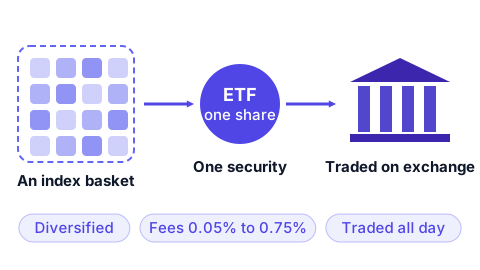
Exchange-Traded Funds (ETFs) are investment funds that trade on stock exchanges like individual stocks, offering investors instant diversification at low costs. These funds typically track an index, sector, theme, or specific investment strategy, providing broad market exposure through a single security. ETFs have revolutionized investing by democratizing access to sophisticated investment strategies and global markets, making it possible for individual investors to build diversified portfolios with minimal capital and expertise requirements.
ETFs can be categorized by asset class, strategy, and geography, offering unprecedented investment flexibility. Equity ETFs track stock indices like the S&P 500 or MSCI World, while bond ETFs provide exposure to government, corporate, or high-yield debt markets. Commodity ETFs track precious metals, energy, or agricultural products without requiring physical storage. Currency ETFs offer exposure to foreign exchange movements. Strategic classifications include index ETFs for passive, low-cost investing; smart beta ETFs that focus on specific factors like value or momentum; thematic ETFs targeting trends like clean energy or artificial intelligence; and inverse or leveraged ETFs for sophisticated trading strategies. Geographically, ETFs can provide domestic exposure, access to international developed markets, or emerging market opportunities.
ETFs offer compelling advantages including instant diversification across hundreds or thousands of securities, low expense ratios typically ranging from 0.05% to 0.75%, intraday liquidity allowing real-time trading, complete transparency with daily holdings disclosure, and tax efficiency through in-kind redemptions. However, investors should be aware of potential drawbacks such as tracking error where the ETF may deviate from its underlying index, counterparty risk in synthetic ETFs that use derivatives, and bid-ask spreads that can impact trading costs, particularly in less liquid markets. Despite these considerations, ETFs have become essential building blocks for modern portfolio construction.
Leveraged and inverse ETFs carry one further drawback, specific to them and absent from the list above. They deliver a multiple of the index return each day and then start the next day from the new balance, so the multiple applies to the daily move rather than to the move across the period you hold them. On a path that rises and falls and comes back to where it began, the index is flat and the fund is not: it is down, and it is down further the more the path swung along the way. The effect grows with the holding period and it does not spare the inverse ones, which lose roughly as much as a two times fund on the same path. It is separate from fees and from tracking error, and it survives even when both are zero, which is why these products are described as instruments for short holding periods rather than as long term exposure.