
Greeks
The numerical indicators that express the different components that determine the price of an option are called "greeks" (because letters from the Greek alphabet are used). Each Greek then estimates the risk of a particular variable that affects the value of the option. The main ones are five: delta, gamma, theta, vega, rho.
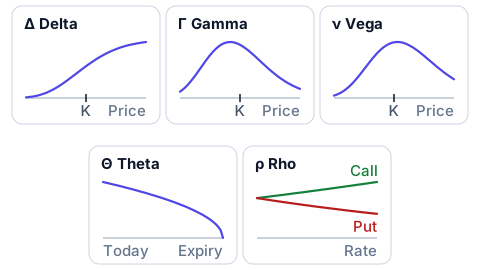
Δ (delta): delta measures the sensitivity of option prices to movements in the underlying market and helps to calculate the change in option price for each point of movement in the underlying, assuming all other factors remain constant.
In financial terms, the delta of a Call option defines the probability that the Call option will expire ITM and that the Put will expire OTM. The delta of a Put option defines the probability that the Put option will expire ITM and that the Call will expire OTM.
Essentially it measures the directionality of the position taken. It is defined as the rate of change in the option price relative to the price of the underlying asset.
If V is the value of the option, and S is the price of the underlying instrument, then delta is defined as: Δ = ∂V/∂S. Therefore, it is the derivative of the option price with respect to the price of the underlying asset (that is, it's the slope of the curve that relates the option price to the price of the underlying asset).
γ (gamma): gamma indicates how much delta changes in response to changes in the underlying price. It measures the rate of change of Δ (delta) with respect to movements in the underlying price.
The formula is Γ = ∂∆/∂S. It indicates how much Δ (delta) changes in response to variations in the underlying price. Therefore, it measures the "speed" of changes in Δ (delta). It can thus be said that Γ (gamma) is also the second derivative of the option value with respect to the underlying price: Γ = ∂2V/∂S^2.
If Γ (gamma) is small, Δ (delta) changes slowly as the underlying price varies. If, however, Γ (gamma) is large, Δ (delta) is very sensitive to changes in the underlying price. The value of this Greek has a bell-shaped distribution and is maximum at ATM (At The Money).
ρ (rho): rho shows the sensitivity of the option value to changes in interest rates (it is the least important of the Greeks) and represents the sensitivity of the option value to the interest rate. ρ = ∂V/∂r.
It shows the sensitivity of the option value to changes in interest rates. It is positive for calls and negative for puts.
Θ (theta): theta measures the time decay of options, that is, it indicates the change in an option's price as it approaches expiration, assuming all other factors remain constant.
Theta represents the rate of change in the option's value with respect to time passage.
If V is the option value, and t is time, then theta is defined as Θ = ∂V/∂t. It measures the time decay of the option, meaning it indicates how the option's price changes as it approaches expiration, assuming all other factors remain constant.
ν (vega): vega measures an option's sensitivity to the underlying market's volatility, or how much an option's value will change for each 1% change in volatility.
It is therefore the derivative of the option price with respect to volatility: vega = ∂V/∂σ. It essentially measures how much an option's value will change for each 1% change in volatility.
Generally, the change will be larger if the expiration is further away. High volatility inflates option prices while, conversely, low volatility makes them fall. Has the same bell-shaped wave form as Γ (gamma), but this time centered on the strike price If we are buyers, we benefit from increased volatility (positive vega); if we are sellers, we are disadvantaged (negative vega).