
Inflation
In economics, inflation refers to a generalized and continuous increase in prices over time. It is a crucial indicator because the price level influences household purchasing power, the overall economic trend, and the orientation of central banks' monetary policies. To calculate inflation, it's necessary to construct a consumer price index, and in most countries, the measurement of this index is attributed to the national statistical institute. The consumer price basket includes, for example, with varying relative weights, the prices of clothing and footwear, food products, healthcare services, transport, electricity, water, and so on.
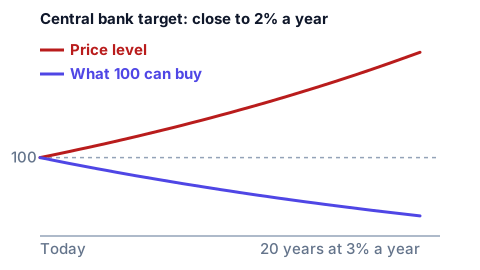
Price stability is considered one of the basic conditions for an increase in the level of economic activity and employment. Rapidly rising inflation can indeed erode household purchasing power, effectively impoverishing them. Conversely, deflation, which is negative inflation with falling prices, can block the economy because, to simplify, companies' selling prices do not cover production costs and send them into crisis. In any case, excessively high or low levels of inflation scare investors and damage confidence, negatively affecting economic activity. For these reasons, central banks set inflation targets to which they anchor their monetary policy, both for conventional interventions on key interest rates and for unconventional ones, such as Quantitative Easing (QE).
The ECB's objective is to bring inflation to a level close to but below 2%, although in recent years a symmetric approach has been promoted, meaning the target can be reached from both below and above (in other words, there is no ceiling at 2%, but any price deviations can occur in one direction or another). This price level is considered optimal by most central banks worldwide for the various actors in the economic context.