
Jensen's Alpha
Jensen's Alpha is a risk-adjusted performance measure that represents the average return on an investment above or below what was predicted by its risk level. It essentially tells you if an asset has 'beaten the market' after accounting for the risk taken. If the Alpha is positive, the asset has generated excess returns; if negative, it has underperformed relative to its theoretical risk profile.
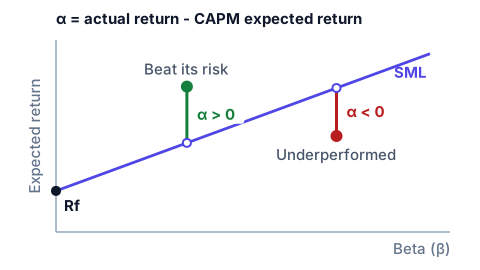
Unlike simple returns, Alpha isolates the "skill" of the asset selection from the "luck" of simply being exposed to a rising market. It is calculated by taking the actual return and subtracting the return that the asset "should" have earned based on the risk-free rate and its market sensitivity. A high Alpha combined with a low Beta is often considered the "Holy Grail" of investing, indicating superior returns with controlled market exposure.