
Macroeconomics
Macroeconomics studies the behavior and performance of entire economies, analyzing aggregate indicators like gross domestic product (GDP), inflation rates, unemployment levels, and national income. This field examines how these large-scale economic factors interact and influence each other, providing the foundation for understanding economic cycles, policy decisions, and market movements. For investors and financial professionals, macroeconomic analysis is essential for making informed decisions about asset allocation, risk management, and identifying investment opportunities across different market conditions.
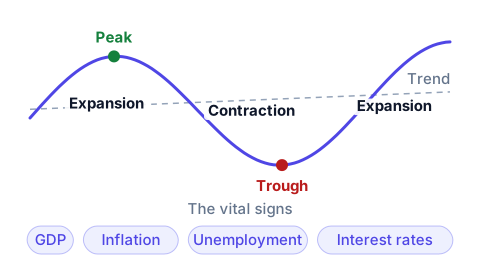
Key macroeconomic indicators serve as the vital signs of an economy's health. Gross Domestic Product (GDP) measures the total value of goods and services produced within a country, indicating overall economic activity and growth trends. Inflation, typically measured by the Consumer Price Index (CPI) or Producer Price Index (PPI), reflects the rate at which prices rise over time, affecting purchasing power and monetary policy decisions. Unemployment rates indicate labor market health and consumer spending capacity. Other crucial indicators include retail sales, industrial production, housing starts, and consumer confidence surveys. These metrics are often categorized as leading indicators (predicting future economic activity), coincident indicators (reflecting current conditions), or lagging indicators (confirming trends after they occur).
Economic cycles represent the natural fluctuation of economic activity over time, typically consisting of four phases: expansion, peak, contraction (recession), and trough. During expansion periods, GDP grows, unemployment falls, and consumer spending increases, generally favoring risk assets like stocks. Peaks mark the end of expansion before economic activity begins to decline. Contraction phases see reduced economic output, rising unemployment, and decreased consumer spending, often leading investors toward safe-haven assets like government bonds. Troughs represent the lowest point before recovery begins. Understanding these cycles helps investors anticipate market behavior, as different asset classes perform differently during each phase. Central banks and governments use fiscal and monetary policies to moderate these cycles, influencing interest rates, money supply, and government spending to promote stability and growth.
Currency markets and international trade dynamics significantly impact global financial markets and investment decisions. Exchange rates between major currencies like the US Dollar, Euro, British Pound, and Japanese Yen fluctuate based on relative economic strength, interest rate differentials, political stability, and trade flows. Trade balances, measuring the difference between exports and imports, affect currency values and economic growth. A trade surplus typically strengthens a currency, while deficits may weaken it. Global trade patterns, supply chain disruptions, and trade policies can create ripple effects across markets. For investors, currency movements affect international investments, commodity prices (often priced in USD), and multinational company earnings, making foreign exchange considerations crucial for portfolio management and risk assessment.
The distinction between fiscal and monetary policy represents two primary tools governments use to influence economic conditions, each with different market implications. Fiscal policy involves government spending and taxation decisions made by elected officials, directly affecting economic demand through infrastructure investment, social programs, or tax changes. Expansionary fiscal policy (increased spending or tax cuts) typically stimulates economic growth but may increase inflation and government debt. Monetary policy, controlled by central banks, manages money supply and interest rates to influence borrowing costs and economic activity. These policies often work in tandem but can sometimes conflict, creating complex market dynamics. Investors must understand both policy types as they affect asset prices, sector rotation, currency values, and inflation expectations, ultimately shaping investment strategies and market sentiment.
Global economic interconnectedness means that macroeconomic events in major economies create spillover effects worldwide. The concept of economic contagion describes how financial crises or economic shocks in one country can rapidly spread to others through trade relationships, financial linkages, and investor sentiment. For example, a recession in the United States often impacts global markets due to reduced demand for imports, affecting emerging market exporters. Similarly, China's economic slowdown can influence commodity prices globally, impacting resource-rich nations. International capital flows respond to relative economic conditions, with investors seeking higher returns or safer havens, creating feedback loops that amplify economic trends across borders.
Geopolitical factors increasingly influence macroeconomic conditions and market behavior in our interconnected world. Political stability, international relations, trade agreements, and conflicts can significantly impact economic growth, inflation, and market sentiment. Events such as Brexit, trade wars, sanctions, or military conflicts create uncertainty that affects currency values, commodity prices, and risk premiums across asset classes. Central bank independence, regulatory changes, and government policy credibility also influence investor confidence and capital allocation decisions. Smart investors monitor geopolitical developments alongside traditional economic indicators to anticipate market movements and adjust their strategies accordingly.
The relationship between macroeconomic conditions and different asset classes follows observable patterns that guide investment strategy. During economic expansion with moderate inflation, stocks typically outperform as corporate earnings grow, while bonds may underperform due to rising interest rates. In recessionary periods, government bonds often provide safety as investors flee to quality, while stocks may decline due to reduced earnings expectations. Commodities generally benefit from inflation and economic growth but can be volatile during demand shocks. Real estate investment trusts (REITs) tend to perform well during stable economic growth with moderate interest rates. Understanding these relationships helps investors construct portfolios that perform well across different macroeconomic environments through strategic asset allocation and tactical adjustments.