
Markowitz Portfolio Optimization
Also known as Modern Portfolio Theory (MPT), it's a mathematical framework for assembling a portfolio of assets that maximizes expected return for a given level of risk, or equivalently minimizes risk for a given level of expected return.
It has had a profound impact on investment management and has led to the development of a wide range of portfolio construction techniques used by financial advisors, fund managers, and institutional investors globally.
Harry Markowitz was awarded the Nobel Memorial Prize in Economic Sciences in 1990 for his work on portfolio theory, sharing the prize with Merton Miller and William Sharpe, whose work on the Capital Asset Pricing Model (CAPM) built upon Markowitz's foundation.
The fundamental idea of Markowitz's model is that a rational investor should not simply seek to maximize returns, but rather also consider the risk associated with those returns, aiming to optimize the overall portfolio. The heart of Markowitz's theory is portfolio optimization. The main objective of this theory is to construct a portfolio that offers the best trade-off between expected return and risk. In this context, the expected return is the weighted average of the expected returns of individual assets in the portfolio, while risk is represented by the variance or standard deviation of returns. Markowitz demonstrated that it's not enough to choose securities that offer the maximum expected return: it's essential to consider the correlation between assets, that is, how the returns of different securities influence each other.
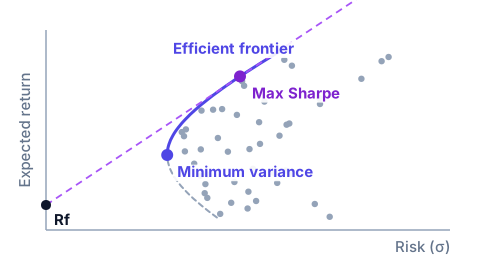
By combining securities that have low or negative correlations, it's possible to reduce the overall volatility of the portfolio and, therefore, the risk, without necessarily sacrificing return. The efficient frontier, in other words, consists of those portfolios that optimize the trade-off between risk and return. A portfolio located on the efficient frontier is considered "efficient," because there exists no other portfolio with the same level of risk that offers a greater expected return, nor a portfolio with the same expected return that presents lower risk.
The model assumes the existence of perfect markets, where there are no transaction costs, taxes, or restrictions on short selling. In reality, these factors can significantly influence investment decisions and portfolio efficiency. The theory is based on the assumption that asset returns follow a normal (or Gaussian) distribution. In practice, returns often exhibit fatter tails (meaning extreme events are more common than predicted by a normal distribution) and asymmetry. The model assumes that estimates of expected returns, variances, and correlations are stable over time. These parameters, in reality, can vary significantly due to changes in market conditions.
The Sharpe ratio, developed by William Sharpe, is a measure used to evaluate the risk-adjusted performance of an investment or portfolio. It is calculated by subtracting the risk-free rate from the expected portfolio return, then dividing by the portfolio's standard deviation (volatility).
This ratio is particularly significant in the context of the Markowitz Portfolio Theory, as it helps investors identify optimal portfolios on the efficient frontier. A higher Sharpe ratio indicates better risk-adjusted performance, allowing investors to compare investment opportunities while accounting for both returns and risks in a single metric.