
Mean Reversion
Mean reversion is a fundamental concept in finance suggesting that some asset prices tend to return to their long-term average over time. This principle assumes that extreme price movements in either direction are temporary and will eventually reverse toward historical norms. Mean reversion strategies capitalize on these reversals by buying oversold assets and selling overbought ones. The concept applies across various markets and timeframes, from short-term trading to long-term investment strategies. Understanding mean reversion helps investors identify potential turning points, manage risk, and develop systematic approaches to market timing and volatility trading.
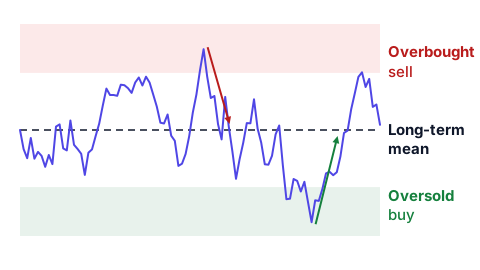
Mean reversion principles apply on many financial markets and asset classes, like volatility, currency, commodities or equity. In equity markets, contrarian strategies buy stocks after significant declines and sell after major advances, assuming prices will revert to fair value. Statistical arbitrage uses mathematical models to identify pairs or baskets of securities that have diverged from historical relationships. Currency markets often exhibit mean reversion as exchange rates tend to return toward purchasing power parity over long periods. Commodity prices frequently mean revert due to supply and demand adjustments. Risk management is crucial in mean reversion strategies, as trends can persist longer than expected, leading to significant losses. Successful mean reversion trading requires disciplined risk management, proper position sizing, and recognition that while mean reversion is a powerful force, it does not guarantee immediate reversals.