
Microeconomics
Microeconomics examines the behavior of individual economic units such as consumers, firms, and industries, focusing on how they make decisions regarding the allocation of scarce resources. Unlike macroeconomics which studies entire economies, microeconomics analyzes specific markets, pricing mechanisms, and the factors that influence supply and demand for particular goods and services. For investors and financial analysts, microeconomic principles are fundamental for understanding company valuations, industry dynamics, competitive positioning, and consumer behavior patterns that drive business performance and stock prices.
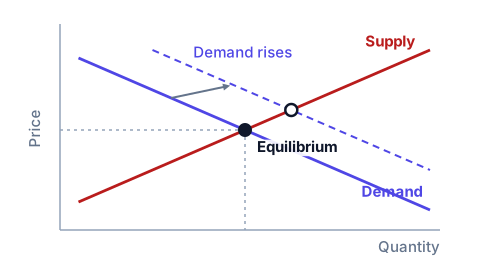
Supply and demand dynamics form the cornerstone of microeconomic theory and directly impact individual company performance and sector valuations. The law of demand states that as prices decrease, quantity demanded increases, while the law of supply indicates that higher prices encourage greater production. Market equilibrium occurs where supply and demand curves intersect, determining both price and quantity sold. Price elasticity measures how responsive demand is to price changes: luxury goods typically have high elasticity while necessities have low elasticity. Understanding these concepts helps investors analyze how companies might perform under different pricing scenarios, assess the impact of cost changes on profitability, and evaluate market positioning strategies. Companies operating in markets with inelastic demand often enjoy pricing power and more stable revenues.
Market structures significantly influence company performance, competitive dynamics, and investment attractiveness. Perfect competition features many firms selling identical products with no barriers to entry, leading to minimal profit margins and commodity-like businesses. Monopolistic competition involves many firms selling differentiated products, allowing some pricing power through brand loyalty or product features. Oligopolies consist of few large firms dominating markets, often seen in industries like telecommunications or airlines, where companies can influence prices but must consider competitor reactions. Monopolies represent single sellers with significant barriers to entry, typically regulated utilities or companies with strong intellectual property protection. Each structure presents different risk-return profiles for investors, with monopolies often offering stable cash flows but regulatory risks, while competitive markets may provide growth opportunities but with margin pressure.
Consumer behavior analysis provides crucial insights for evaluating companies and predicting market trends. Consumer choice theory explains how individuals maximize utility given budget constraints, helping analysts understand demand patterns for different products and services. Income and substitution effects describe how consumers respond to price changes: higher incomes generally increase demand for normal goods while decreasing demand for inferior goods. Consumer preferences, including factors like brand loyalty, quality perception, and convenience, directly impact companies' pricing power and market share. Behavioral economics adds psychological factors to traditional models, explaining phenomena like loss aversion, anchoring bias, and herd behavior that influence purchasing decisions and create market inefficiencies that skilled investors can exploit.
Production theory and cost structures are fundamental for analyzing company efficiency, scalability, and competitive advantages. Firms aim to maximize profits by optimizing the combination of inputs (labor, capital, materials) to produce outputs most efficiently. Fixed costs remain constant regardless of production volume, while variable costs change with output levels. Understanding economies of scale helps identify companies that can reduce per-unit costs as they grow, creating competitive moats and margin expansion opportunities. Diseconomies of scale occur when companies become too large to operate efficiently. The concept of marginal cost versus marginal revenue determines optimal production levels and pricing strategies. Investors use these principles to evaluate operational efficiency, assess scalability potential, and compare companies within the same industry based on their cost structures and production capabilities.
Market failures and externalities create investment opportunities and risks that microeconomic analysis helps identify. Information asymmetries occur when one party has more information than another, such as management knowing more about company prospects than shareholders, potentially leading to mispricing. Network effects create value that increases with the number of users, often seen in technology platforms and creating powerful competitive advantages. Externalities represent costs or benefits not reflected in market prices, such as environmental impacts or social benefits, increasingly important for ESG investing. Government interventions through regulations, taxes, or subsidies can significantly impact individual companies and sectors. Understanding these microeconomic concepts helps investors identify market inefficiencies, anticipate regulatory changes, and evaluate the sustainability of competitive advantages in their investment analysis.