
Monte Carlo Simulation
Monte Carlo simulation is a computational algorithm that relies on repeated random sampling to obtain numerical results. In finance, it is used to model the probability of different outcomes in processes that are inherently uncertain. By generating thousands of potential price paths for an asset, the simulation provides a distribution of possible results, allowing for an analysis of risk and reward that goes beyond simple deterministic projections.
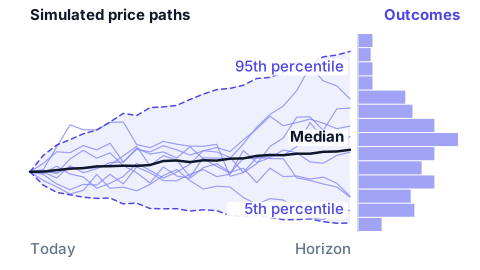
The Accuracy of Distributions: Normal vs. Johnson SU. A critical factor in simulation reliability is the underlying probability distribution. While the Normal Distribution (Gaussian) is a common standard, it often fails to account for 'Kurtosis' (extreme events) and 'Skewness' (asymmetry) observed in real market data. The Johnson SU distribution is a more flexible four-parameter system that can be precisely calibrated to match the empirical characteristics of a specific asset. This approach provides a more accurate representation of 'fat tails,' ensuring that the frequency and magnitude of market crashes are not statistically underestimated.
Application in Financial Planning. In the context of long-term wealth management, Monte Carlo analysis is used to evaluate the viability of withdrawal strategies and retirement horizons. By utilizing the Johnson SU distribution, the simulation accounts for the sequence-of-returns risk and the impact of non-normal market shocks on capital longevity. Key outputs include the 'Success Probability', the statistical likelihood that a portfolio remains solvent, and 'Ruin Analysis,' which identifies the specific conditions and timeframes under which capital exhaustion occurs.
Application in Strategy Robustness. For derivative and options strategies, Monte Carlo simulation serves as a validation tool against 'overfitting' in historical backtests. By testing a strategy configuration against thousands of synthetic price paths generated through the Johnson SU model, it is possible to determine if historical performance was a result of a robust edge or a statistical anomaly. This methodology allows for the calculation of probability metrics, such as the chance of maintaining a positive Sharpe ratio or the likelihood of profit across diverse, yet statistically plausible, market environments.
Limitations and Assumptions: while Monte Carlo simulation is a powerful analytical tool, users must understand its inherent constraints. The model's accuracy is fundamentally dependent on the quality of historical calibration: poor or unrepresentative data will produce unreliable forecasts. Critically, the simulation operates under the assumption of statistical stationarity: that the future will resemble the past in terms of return patterns, volatility regimes, and correlation structures. This means that unprecedented 'Black Swan' events, those without historical precedent, remain inherently difficult to model. Structural market changes, regime shifts, or systemic disruptions may not be adequately captured, making the simulation a guide rather than a guarantee. Investors should interpret probability outputs as conditional scenarios based on historical norms, not absolute certainties.