
What are options?
Options are financial instruments whose value is derived from the price of an underlying asset of various kinds (real as in the case of commodities such as grain, gold, oil, etc., or financial as in the case of stocks, bonds, exchange rates, indices, etc.).
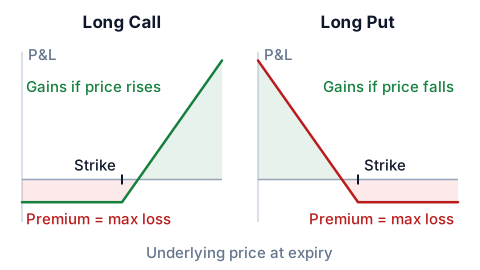
Options are contracts that give the buyer the right, but not the obligation, against payment of a price (premium), to exercise the right to buy (Call) or sell (Put) a given quantity of a given asset, called the underlying asset, at or by a specified expiration date and at a specified strike price.
The option buyer has the option not to exercise his or her right at expiration (or by expiration for U.S. options), hence the limit on the losses that can be incurred. In contrast, the seller always has an obligation to honor the commitment under the option he has granted to the buyer.
Put allows the buyer to gain if the market goes down. The buyer of put options wants to bet on the market going down and without exposing himself to possible losses if the market goes in the opposite direction than hoped for.
Call allows the buyer to gain if the market goes up. The call option buyer wants to bet on the market going up and without exposing himself or herself to possible losses if the market went in the opposite direction than hoped for.
Option Buyer: the purchase of a Call confers the right to buy the underlying asset at the price defined by the strike by a specified expiration date; purchase of a Put confers the right to sell the underlying asset at the strike price by a specified expiration date.
Option Seller: the sale of a Call implies the assignment of the right, whereby you are obligated to sell the underlying asset at the strike price by a specified expiration date; the sale of a Put implies the assignment of the right, whereby you are obligated to buy the underlying at the strike price by a specified expiration date.