SEC and SEC EDGAR
The U.S. Securities and Exchange Commission (SEC) is an independent federal government agency responsible for protecting investors, maintaining fair, orderly, and efficient markets, and facilitating capital formation. Established in 1934 following the stock market crash of 1929, its primary mission is to ensure that public companies tell the truth about their businesses and that the brokers, dealers, and exchanges who trade securities treat investors fairly.
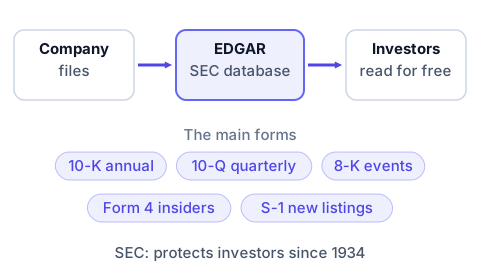
EDGAR stands for the Electronic Data Gathering, Analysis, and Retrieval system. It is the primary public database used by the SEC. It allows all public companies, foreign and domestic, to file required financial statements and registration statements electronically. As of 2026, EDGAR provides free, real-time access to millions of company filings, such as annual reports (Form 10-K), quarterly reports (Form 10-Q), and insider trading disclosures. It is the standard tool for investors, analysts, and researchers to verify the financial health and legal compliance of companies traded on U.S. stock exchanges.
The documents filed with the SEC via the EDGAR system provide different views of stocks financial health. They can be broadly divided into mandatory filing forms (like 10-K and 10-Q) and the core financial statements contained within them (Balance Sheet, Income Statement, Cash Flow Statement).
Form 10-K (Annual Report): this is the comprehensive annual report required by the SEC. It is far more detailed than the glossy annual report sent to shareholders. It provides a thorough overview of the company's business and financial condition and includes the audited financial statements. Foreign companies typically use Form 20-F for their annual reports or Form 40-F (specifically for certain large Canadian companies).
Form 10-Q (Quarterly Report): this is the quarterly version of the 10-K. It contains unaudited financial statements for the most recent quarter and provides a continuing view of the company's financial position and operations throughout the year.
Form 8-K (Current Report): this form is used to announce major events that shareholders should know about immediately. Companies must typically file an 8-K within four business days of a significant event, such as a material acquisition, a change in management, bankruptcy, or a delisting of stock.
Form 3 (Initial Statement of Beneficial Ownership): This form must be filed when an individual first becomes an 'insider' (officers, directors, or owners of more than 10% of a company's stock). It provides a snapshot of their holdings at the time they reach this status. Even with 0 shares, an insider must file Form 3 because it establishes the initial baseline of their ownership, and the filing captures the exact portfolio at that moment, even if empty, to ensure transparency and prevent insider trading. Being an insider is determined by role (director, officer, or >10% owner), not by shares held.
Form 4 (Statement of Changes in Beneficial Ownership): This is one of the most closely watched filings. It must be filed within two business days of any transaction (buy, sell, or exercise of options) involving company stock by an insider. Investors track Form 4 filings to see if executives are putting their own money at risk, which is often interpreted as a signal of confidence in the company's future.
Form 5 (Annual Statement of Beneficial Ownership): This is an annual summary filed by insiders to report any transactions that should have been reported earlier on a Form 4 but weren't, or transactions that are exempt from immediate reporting, such as small gifts of shares. It ensures that the SEC and the public have a complete and accurate record of insider ownership at the end of the fiscal year.
Form S-1 (Registration Statement): This is the initial registration form required by the SEC for new securities offered by public companies. It is most commonly associated with an Initial Public Offering (IPO). The S-1 contains crucial information such as the planned use of capital proceeds, the company's business model, competition, risk factors, and audited financial statements. It is the primary document investors use to evaluate a company before it begins trading on a public exchange.