Structured certificates
A structured certificate is not a new kind of asset. It is a package, and underneath it there is a bond issued by a bank, one or more options, and the dividends you give up by holding the certificate instead of the shares.
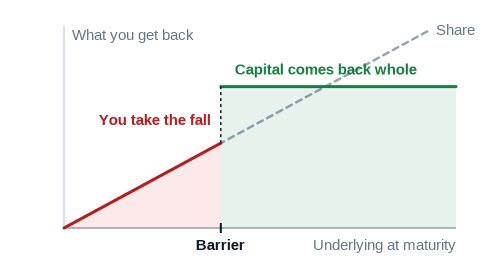
The bond part is what gives you your money back. The options part is what shapes the rest: a call you own turns a rise into a gain, a call you sold caps that gain, a put you sold is what can take your capital away. Nothing in a certificate is free. Every promise written on the front page is paid for by something written on the back.
Where does the yield actually come from? Mostly from two places. The first is the dividends: a certificate follows the share price but does not pay you the dividends, and on a share yielding 6 percent over two years that is roughly 11 percent of your capital handed over before anything else happens. The second is the options sold inside the product, usually a put below a barrier.
The barrier is the level that decides whether your capital comes back whole. Below it, you stop being protected and you take the fall of the underlying. Two certificates with the same barrier can still be very different, because what matters just as much is when the barrier is watched: only on the final day, or every single day of the product life. A barrier watched every day is far easier to break.
The main families are easier to remember by what they give up. Capital protected keeps your money safe and buys you a limited rise. Discount hands you the share at a lower price but caps your gain. Bonus and Bonus Cap pay a fixed amount if the barrier holds. Airbag softens the fall below the barrier instead of taking it one for one. Reverse convertible and Phoenix pay you coupons and in exchange you carry the downside.
It is worth becoming familiar with the terms used in a term sheet, since every analysis of these products relies on them. A coupon TRIGGER is the level the underlying must hold for a coupon to be paid. MEMORY means a coupon you missed is not lost, it is paid later if the trigger is met again. AUTOCALL means the product can repay you early, on a date when the underlying is above a level. STEP DOWN means that level drops over time, so an early exit becomes easier month after month. WORST OF means the rule looks at the weakest of several shares, not at their average.
There is a risk that no payoff diagram shows: the issuer. A certificate is an unsecured claim on the bank that issued it, so if the bank fails you are a creditor, whatever the underlying did. That risk is priced, and it discounts the whole product and not just its bond part. A wider issuer spread is one of the quiet reasons a certificate can look generous.
Three checks are advisable before subscribing to a certificate. First, the distance between the underlying and the barrier at the current date, expressed as a percentage. Second, whether the barrier is observed daily or only at maturity. Third, the fair value of the product compared with its price, since the difference reflects the issuer margin and the distribution costs included in the price.
Looking at a certificate? See what is inside it and what you pay for →