
Volatility
Volatility quantifies significant price fluctuations of an asset or financial instrument. Higher volatility increases the likelihood of either very high or very low performance, meaning there's a greater chance of substantial price movements, both upward and downward. Beyond its use as a risk indicator, volatility can also be defined as an asset class in itself. By utilizing derivative instruments such as options, futures, forwards, and swaps, volatility can be integrated into a balanced portfolio to boost exposure to market sentiment.
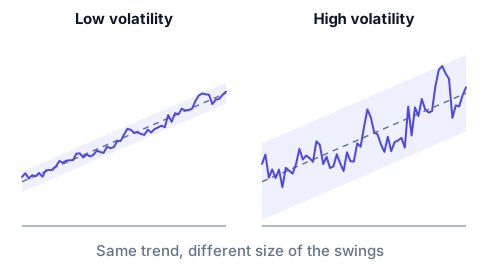
Financial market participants employ various indices to monitor volatility within specific asset classes. The VIX index (short for Volatility Index) is the most widely followed volatility index for analyzing sentiment and direction in the American stock market. Established in 1993 by the Chicago Board Options Exchange, now Cboe, this metric aims to quantify the expected future volatility of the primary U.S. stock index, the S&P 500, over the subsequent 30 days. In essence, the VIX measures price oscillation expectations embedded in S&P 500 options. In Europe, the VSTOXX index is used to gauge expected volatility on the Euro Stoxx 50 index. For the bond market, the MOVE index measures the volatility of options traded on U.S. Treasury securities and serves as the bond market equivalent to the VIX. Its calculation is based on the implied volatility of 1-month options on 2, 5, 10, and 30-year Treasury futures.
In the financial markets, volatility leads to what is known in finance as "loss aversion". This is the tendency for investors to liquidate losing positions more quickly than profitable ones, resulting in capital flight from financial markets and a slowdown in investments, causing instability not only financially but also economically. This can lead to high inflation, hyperinflation, currency crises, debt crises, banking crises, recessions, and depressions as investors and savers lose confidence in the financial system. For instance, the Asian financial crisis of 1997-1998 triggered a massive outflow of capital from countries like Thailand, Indonesia, South Korea, and Malaysia, as their currencies plummeted and their banking sectors faced the risk of insolvency. Economic instability can worsen the risk/reward ratio of domestic investments, potentially prompting investors to seek greater security elsewhere.