
Yield Curve
The yield curve represents the relationship between interest rates and time to maturity for bonds of similar credit quality, typically government securities. This fundamental tool displays yields on the vertical axis and maturities on the horizontal axis, creating a visual representation of the term structure of interest rates. The yield curve serves as a critical benchmark for pricing all debt securities, influences monetary policy decisions, and provides valuable insights into economic expectations. For fixed income investors and portfolio managers, understanding yield curve dynamics is essential for making informed investment decisions, managing interest rate risk, and optimizing portfolio returns.
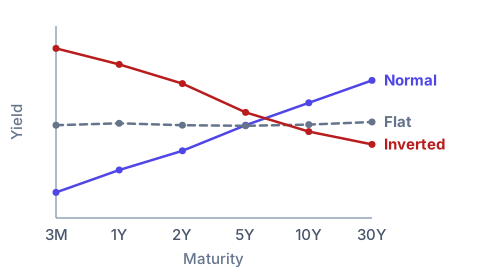
Yield curves can take various shapes, each conveying different economic information and investment implications. A normal or upward-sloping curve shows higher yields for longer maturities, reflecting compensation for inflation risk and uncertainty over time. This shape typically occurs during stable economic conditions with moderate growth expectations. An inverted curve, where short-term rates exceed long-term rates, often signals economic recession expectations and central bank tightening. Flat curves suggest economic uncertainty or transition periods. Steep curves indicate expectations of rising inflation or economic acceleration. Humped curves show intermediate rates higher than both short and long rates, often occurring during monetary policy transitions. These shapes influence investment strategies, with steep curves favoring duration extension and inverted curves suggesting defensive positioning.
Duration measures a bond's price sensitivity to interest rate changes, representing the weighted average time to receive all cash flows. Modified duration quantifies the percentage price change for a 1% interest rate move, making it crucial for risk management. Effective duration accounts for embedded options in bonds like callable or putable features. Portfolio duration equals the weighted average of individual bond durations. Duration management involves strategically adjusting portfolio sensitivity to interest rate movements based on yield curve expectations and risk tolerance. When expecting rising rates, managers reduce duration to minimize price declines. Conversely, when anticipating falling rates, extending duration amplifies potential gains. Advanced strategies include yield curve positioning, where managers adjust exposure to different curve segments, and duration hedging using derivatives to separate interest rate risk from credit risk.
Practical yield curve strategies exploit shape changes and relative value opportunities across the maturity spectrum. Bullet strategies concentrate holdings in specific maturity ranges, while barbell approaches combine short and long maturities, avoiding intermediate terms. Laddering involves purchasing bonds with staggered maturities to manage reinvestment risk and provide steady cash flows. Yield curve flattening trades involve buying long bonds and selling short bonds when expecting curve compression. Steepening trades do the opposite when expecting curve normalization. Duration-neutral strategies focus on relative value without taking directional interest rate bets. Portfolio managers also employ yield curve immunization to match asset duration with liability duration, ensuring portfolio value stability regardless of parallel yield curve shifts.